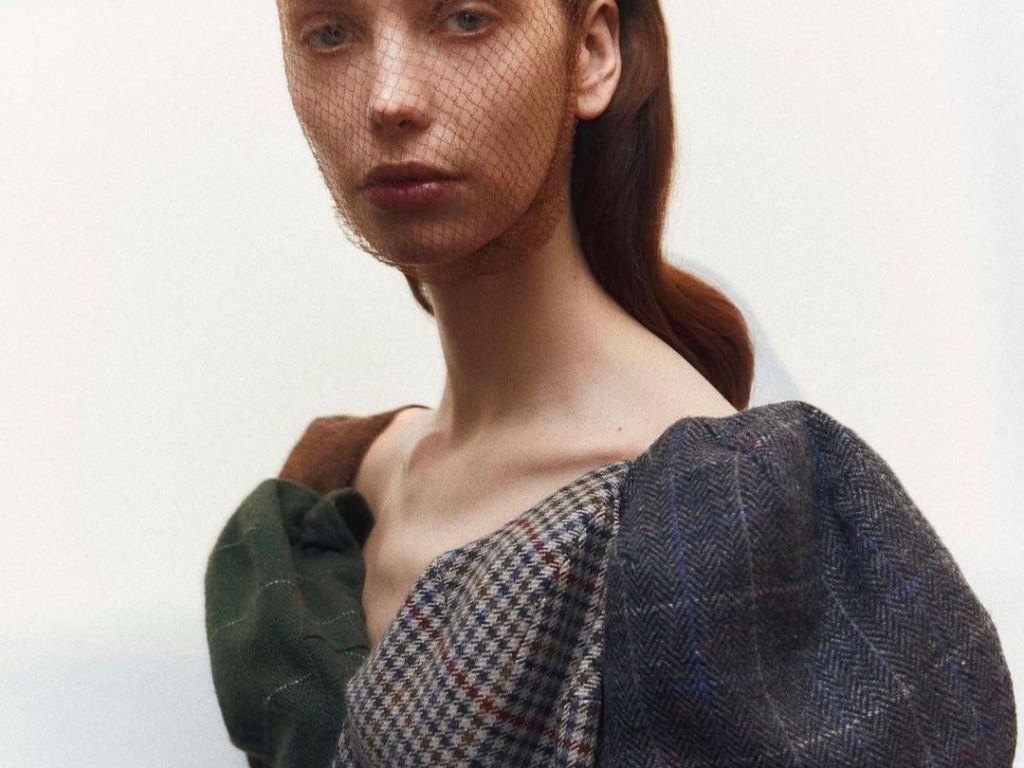
A total look from Ellen Hodakova Larsson’s collection. Image source: Ellen Hodakova Larsson’s IG account @hoda_kova
Fashion mass production became the norm in 1950s, when clothing stores became easily accessible and buying clothes was suddenly more convenient than ever before. And the sustainable fashion movement has began to rise up in 1960s and 1970s through hippies with their simple nomad life with natural choice of fabrics and punks with their love of secondhand clothing and vintage pieces.
Sustainable fashion movements were driven by the severe impacts of mass clothing production on the environment and humanity, that has led to low-wage workers who work in poor and hazardous conditions, and also an increase in waste landfills and pollution, a true cost of choosing quantities over qualities.
Billions of garments produced each year, almost a hundred million tonnes end up in landfills. Fashion waste on the environment being responsible for nearly 10% of global carbon emissions. And the throwaway culture has worsen progressively over the years where many items are worn only seven to ten times before being tossed which continuously piling up on landfills.
So what is upcycled fashion?
It was started during World War II in early 1940s, where the “Make Do and Mend” campaign took place in 1943, initiated by British Ministry of Information as a response to resource scarcity and clothing rationing, encouraging citizens to repair and repurpose worn-out items. And the term of upcycling was first proposed by German engineer, Reiner Pliz. As recycling means diminished the value of old or used products, and upcycling is about adding a new value to the existed product which also reduces the consumption of new raw materials when creating new products.
Here are three inspirational fashion designers who successfully embraced the upcycling methods and inspired the world with their collections:
1.
Marine Serre is a French sustainable fashion designer and the winner of LVMH Award in 2017 who prioritizes sustainability at the heart of her brand. As a teenager, she’d rework her clothes, refresh and customised the old to create something that feels wholly new.
She is the one who has transformed overproduced jacquard towels, vintage crochet and silk scarves, and also tablecloths to a new fashionable collection on runway and has been successfully turning millions of attentions from all generations worldwide. Her signature crescent moon print has been gaining support not only from the fashion industry, but also from numerous international celebrities.
and has been focusing on upcycled or regenerated clothing line since 2017.
She’s developed her own supply chain in her Paris studio to disassemble garments and ready the upcycled materials for manufacturing . Serre’s business is divided into four lines: Red (made-to-order), Gold (high-fashion), Borderline (underwear) and White (elevated basics).
Lately, Marine Serre presented upcycled method and new regenerated materials on her couture line, Sempre Legati at Pitti Uomo 106 in Florence, Italy.
2.
Hideaki Shikama is a designer of Children of the Discordance. He is known for expressing different cultures in his collection. Like bandana prints get paired with tie-dye and camouflage, grey and blue patchwork jeans from Levi’s, shredded outerwear, garments made from football scarves, and more.
The idea was started when he saw his friend wore the American urban streetwear brand, Stüssy and experienced a crossover of different cultures in middle school. He’s also been making new camp caps since he was a kid and also making it for Children of the discordance each season. According to Vogue about his latest collection AW 2024/25, Hideaki Shikama and his team repurpose found materials and deadstock to create new styles, and also make his principle the “one and only” principle truly comes to life. For years the brand has also been working with skilled artisans and workers from different countries like Mexican weavers and Palestinian refugees to construct the label’s post-punk garments and to create the brand’s wares.
3.
Ellen Hodakova Larsson is a Swedish designer. Larsson founded her eponymous label in 2021 shortly after graduating from the Swedish School of Textiles and splits her time between Stockholm and Paris where she presents her deconstructed, upcycled designs. Her approach on upcycled is to give new life to objects and to use unexpected materials such as spoons, old leather belts, or preserved dried fresh petals, and we can clearly see that the core of her business is on sustainability. To provide the source of materials, Hodakova team works with different collaborators such as companies and secondhand stores. For example a traditional men’s suit company in Sweden called Oscar Jacobson that provides her team with their dead-stockdead-stock instead of burning up their overstocks.
The maximum of items to produce is depending on the collaborations and on the quantity of orders from different sales, approximately between three items up to 10 items which provides a space for exclusivity and uniqueness. Hodakova Larsson was listed as one of 100 innovators in Vogue Business in 2023.
Source:
- Crescent Print Gaining Worldwide Popularity – MARINE SERRE’s Fashion Proposals for a Sustainable Future
- Marine Serre’s radical reset: All-female leadership to push deadstock as luxury
- At Pitti Uomo, Marine Serre Sends a Message of Peace and Unity
- Hideaki Shikama, the designer of Children of the discordance, is Building a World from a Melting Pot
- DESIGNER INTERVIEW Vol.03 – Hideaki Shikama, designer for Children of the discordance, talks about archives (Part 2)
- ELLEN HODAKOVA LARSSON SAT DOWN FOR A DESIGNER-TO-DESIGNER CHAT AND SHARED THE JOYS OF UPCYCLING
- ‘THE WORLD DOESN’T NEED ANOTHER DESIGNER’ – ELLEN HODAKOVA LARSSON ON CHANGING FASHION BY JOSHUA GRAHAM ON 21 NOVEMBER 2023
 MAAKNU