
Naju is a city in South Jeolla Province, South Korea – where the past culture integrates with the modern life. Naju also has a great panoramic view of the Yeongsan River, a lifeline for residents of South Jeolla and the Gwangju region – which is located in midwestern area of the province.
According to Korean Times, along the Yeongsan river, people can catch a glimpse of cultural relics and experience an agricultural life. The river is known for its historical blue indigo dyeing tradition that has been passed down through many generations for centuries – where the red amber jjok flowers are also growing as the main source of indigo dye.
It is also where an artisan Jung Kwan Chae doing the preservation of the indigo natural dyeing traditions. Jung Kwan Chae, is the Korea nation’s Important Intangible Cultural Asset No.115, the nation’s top expert in traditional indigo dyeing. According to Arirang News, he has dedicated half of his life to reproducing the Korean traditional indigo dyeing technique known as “jjok yeomsaek” (an all-natural dyeing technique, using a pigment that is extracted from “jjok,” or indigo plant, as its dye source)
“There are many different colors in this world, but I have dedicated my life to the color indigo. I hope to further develop and modernize Korea’s indigo dyeing, and in turn, help the modernized dyeing method to take root,” said the master Jung Kwan Chae during an interview with Arirang News.
The master has been passing down the natural dyeing techniques and knowledge to his students in a 3-year program study and only selected 15 applicants each year. And this year, the 5th group that was started the study in the beginning of 2018, has completed their study with the dye master. They both accepted both theoretical and practical knowledge about various natural dyeing and design techniques from different natural sources and specialized in making the good quality of the historical indigo dyes, under a close attention from the master.
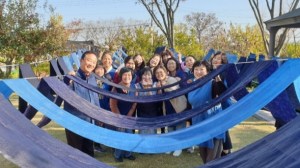

— The master Jung Kwan Chae with Jung정 O오 Ae애 group (left) – Inside the natural dyeing exhibition 쪽, 인연의 끈 Indigo, the string of the faith (right). Image by: the member of Jung O Ae exhibition —
The 5th group, named Jung O Ae, is now holding an exhibition in Natural Dyeing Museum until November 28th this weekend. The meaning behind the 5th group’s name of Jung O Ae: Jung(정) O(오) Ae(애) is the name of the 5th group is. Jung(정) means Jung Kwan Chae / O(오) means 5th (다섯번째) / Ae(애) means love / basically, 정오애 means knowing and meeting 5th members at the master Jung Kwan Chae studio, we love each other. And the title of the exhibition is 쪽, 인연의 끈 (Indigo, the string of the faith).
“Indigo, A String Of Faith“, is the exhibition theme of the Jung O Ae exhibitors which presenting art, fashion, and interior pieces. There are earth colored cubism lamp shades, traditional modern baby clothes and childrenswear, artistic motif patterns on bags, abstract motif patterns of stool motif, contemporary style paintings, to various print styles of pillow covers – all laid out in the museum until this weekend. The exhibition is still going on until November 28th, 2020 in Natural Dyeing Cultural Centre in Naju.

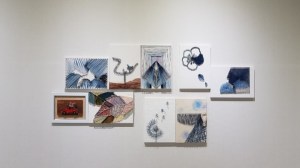
— The creations of the natural dyeing exhibition 쪽, 인연의 끈 Indigo, the string of the faith (right). Image by: the member of Jung O Ae exhibition —
Most of the exhibitors in “Indigo, A String Of Faith”, they are actively creating art pieces, teaching special courses in their own studios, and joining the annual international dyeing competitions, Natural Dyeing Cultural Goods – where people around the world participate in it, especially from Austria, Taiwan, and Japan.
“Since 2018, I have been learning various types and techniques of natural dyes in the studio of dye master, Jeong-Kwan chae (Important Intangible Cultural Heritage No. 115) in Korea. I remember the time when I first experienced dipping the silk scarf into the the pot of indigo and seeing the color changes, It was such breath taking color I’ve never seen. It is incomparable with artificial dyes. Since then, I have continuously been working on this field,” said Mi Young Jung, a product designer who is also one of the Jung O Ae’s exhibitors.
The exhibition and the annual competition are the recent proves that the historical traditional natural dyeing techniques, especially indigo textile dyeing of Naju are still attracting many younger generations from around the world through the hands of the textile dyeing master, Jung Kwan Chae, who is also a high-school art teacher at Yeongsan High School in his hometown, Saetgol Village – where he grew up in the cotton-farming fields of Naju, Jeollanam-do Province.
According to Korea Herald, the commitment of the master Jung Kwan Chae to indigo dyeing had began when he was a 20 years old art student. And he received an indigo plant seed during his study in the university from someone who knew his special artistic talent. As the master had witnessed his mother and grandmother’s daily duties of dyeing and harvesting indigo since he was small. And Jung was the right heir for the preservation of Naju’s natural dyeing.
For more information about Jung Kwan Chae: Website: jungindigo.com
Source: Naju, Dyed in Indigo Blue — Jeong Gwan-Chae, Master of Korean Indigo Dyeing Traditional Method — Deep indigo: Fragrant beauty of Naju.
This page has been updated. 1 update:…
A confirmation of the official website of master Jung Kwan Chae.
 MAAKNU